
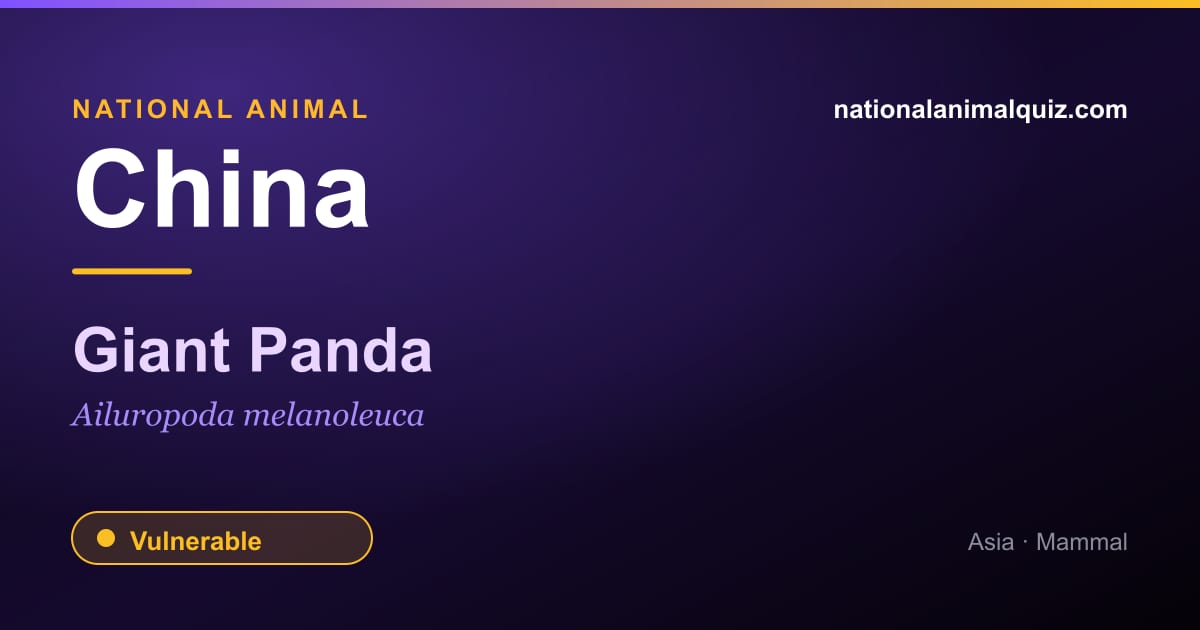
What is China's National Animal?
The Giant Panda
Quick Species Overview
Why is the Giant Panda the National Animal of China?
As China's national animal, the Giant Panda stands for the country's landscape, identity and public heraldry. China loans pandas to other countries as a form of diplomacy. It is listed as Vulnerable, and national recovery efforts have made it a common symbol of habitat restoration.
Across national holidays, sovereign heraldry, and public monuments, the Giant Panda stands as a beloved guardian representing the courage and identity of China.
Key Wildlife & Ecological Facts
Its scientific name is Ailuropoda melanoleuca.
The Giant Panda is a mammal recorded across China's national parks and protected areas, and China uses it as a shorthand for the country's natural heritage.
It is listed as Vulnerable, and national recovery efforts have made it a common symbol of habitat restoration.
Frequently Asked Questions
What is the official national animal of China?
The official national animal of China is the Giant Panda (scientific name: Ailuropoda melanoleuca).
Why was the Giant Panda chosen as the symbol of China?
As China's national animal, the Giant Panda stands for the country's landscape, identity and public heraldry. China loans pandas to other countries as a form of diplomacy. It is listed as Vulnerable, and national recovery efforts have made it a common symbol of habitat restoration.
Is the Giant Panda endangered?
The conservation status of the Giant Panda is currently recognized as Vulnerable.
What is the scientific name of the China national animal?
The Giant Panda is Ailuropoda melanoleuca. It is classified as a mammal in Asia.
Is the Giant Panda the only national animal in Asia?
No. China is the only country in our 32 other Asia entries to use the Giant Panda, but all Asia countries in the quiz have a national animal of their own, and no species is used by every country on the continent.
Can you guess China on the 3D globe?
Test your geography skills in today's daily puzzle. Guess countries by their national animal clues with thermal distance feedback.